
An innovative step forward with AI
Non-contacting rotary encoders measure without any mechanical coupling between the shaft and the sensing system. This makes them robust and wear-free, but it requires the magnet to be positioned accurately. Radial offset and tilt feed directly into the measurement error, and a bearing that loses stability on the application side degrades the signal over the service life.
The new technology considerably reduces this dependency. Without compensation, the specified non-linearity of ≤ 0.3 % FS applies up to a radial offset of R = 1 mm; beyond that, the angular error increases with the offset. AI-based models, developed and trained at Contelec, keep the non-linearity at ≤ 0.3 % FS across the entire tolerance range up to R = 4 mm (magnet type H, D30 × 6.5 mm).
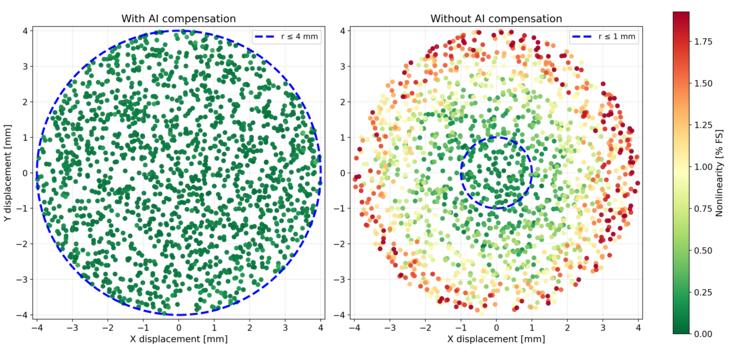
Measured non-linearity of a Vert-X 32E across the entire tolerance range (R = 4 mm), with and without AI compensation
More freedom in design and assembly
Within the specified tolerance range, radial offset and tilt of the magnet no longer have a direct effect on the measurement error. For the design engineer, this means lower requirements on manufacturing and assembly tolerances and more scope when integrating the encoder into existing installation spaces.
This also pays off in service: the sensor can be replaced in the field with standard tools, and no alignment is required.
Compensating mechanical changes during operation
The models continuously compensate for magnet tilt of up to 2°. This also applies when the tilt only develops during operation, for example because the bearing on the application side loses stability over time. Measurement accuracy therefore remains stable over the service life of the application, with no readjustment.
Detecting movement patterns, planning maintenance
In addition to the angle signal, the algorithms estimate the mechanical position of the magnet. Changes in position and increasing bearing play therefore become measurable before they affect measurement accuracy. This information can be used for predictive maintenance.
Availability and integration
The AI models run on the sensor electronics and are available today for non-contacting rotary encoders with a CAN interface. The technology is implemented in the Vert-X 32E. For further sizes, magnets and interfaces, please get in touch with us.
Your benefits with our AI technology at a glance
- Non-linearity of ≤ 0.3 % FS across the entire tolerance range: radial offset up to R = 4 mm and magnet tilt up to 2°
- More freedom in design and assembly, with lower requirements on manufacturing and assembly tolerances
- Sensor replacement in the field with standard tools, no alignment required
- Continuous compensation of mechanical changes during operation
- Detection of changes in position and bearing play as a data basis for predictive maintenance
Would you like to know more about integrating our AI technology into your system architecture?
Where are you reaching tolerance limits today? Our specialists will be glad to support you in finding the optimum design for your application.
Engineering consulting